
Every property has slightly different fencing requirements. A straightforward level boundary may work well with standard brush fence panels, while a sloping garden, narrow side passage or existing retaining wall can require something more specific.
That is where custom brush fence panels become useful. Rather than forcing a standard panel into a space for which it was never designed, the dimensions and layout can be adapted to the property. This can produce better coverage, more balanced proportions and a cleaner finished appearance.
Understanding Standard Brush Panel Sizes
Standard sizes provide a useful starting point when planning a new fence. Brush Fence lists commonly used panel dimensions including 1.8 metres by 2.4 metres, 2.1 metres by 2.4 metres and 1.5 metres by 2.4 metres.
These dimensions can work well on relatively straightforward boundaries. However, real properties rarely consist of perfectly level stretches with identical spacing from one end to the other. Gates, corners, garden structures and changes in ground level can all influence the final dimensions.
When Custom Sizing Makes Sense
A custom panel may be useful whenever a standard size would create awkward gaps or require unnecessary changes to the surrounding landscape.
For example, a narrow space between a house and boundary may need a reduced panel width. A retaining wall can change the required height, while an existing gate opening may require the adjoining fence sections to be carefully proportioned.
Using custom-sized brush panels allows the fence to follow the available space rather than making the property adapt to standard manufacturing dimensions.
Designing for Sloping Ground
Sloping blocks create one of the most common challenges in fence design. Installing identical rectangular panels along a noticeable slope can leave gaps underneath or create an uneven top line.
Two common approaches are stepped and raked arrangements. Stepped panels remain level individually but change height as the land rises or falls. Raked fencing follows the slope more continuously.
The right approach depends on the gradient, appearance of the surrounding property and structural requirements. Brush Fence notes that stepped and angled panels can be produced for sloping blocks.
Choosing the Right Fence Height
Height affects privacy, appearance and how enclosed an outdoor area feels. A taller brush fence can create greater separation around entertainment spaces, pools or boundaries exposed to neighbouring properties.
Lower fencing can suit garden screens, decorative divisions and locations where maintaining an open view is important. The company states that custom heights from approximately 900 mm to 2.4 metres or more can be provided, depending on the project.
Local planning and pool-safety requirements should always be checked where relevant rather than choosing height based on appearance alone.
Custom Panels Around Gates
Gates often interrupt an otherwise regular fence line. Standard panels placed beside an unusually sized opening can leave narrow gaps or visually unbalanced sections.
Custom widths make it possible to plan the surrounding panels around the gate rather than treating it as an afterthought. The brush density, height and finish can also be coordinated so the gate feels like part of the same design.
For prominent entrances, the proportions of posts, pillars, capping and surrounding brush can make a noticeable difference to the overall appearance.
Panels for Privacy Screens
Brushwood does not have to be limited to the perimeter of a property. Custom panels can also create screens around patios, outdoor entertaining areas, gardens or sections requiring additional privacy.
Because these installations may occupy smaller spaces, exact dimensions become particularly important. An oversized panel can dominate a compact courtyard, while a panel that is too low may fail to provide the privacy expected from it.
Planning the screen according to sightlines and surrounding structures usually creates a more practical result.
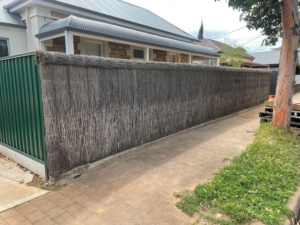
Matching Existing Brush Fencing
Custom panels are also useful when repairing or extending an existing brush fence. An older fence may not correspond with today’s standard panel dimensions, especially if it was originally built specifically for the property.
Measurements should therefore be taken from the existing structure instead of assuming a standard replacement will fit. Brush density and overall proportions should also be considered so that new work does not appear disconnected from the older sections.
Careful matching can be especially useful when only one or two sections need replacement.
Capping as Part of the Design
The top finish contributes both to the appearance of a brush fence and to how complete the installation feels. Different capping approaches can create a softer traditional look or a more structured finish.
Capping should be considered alongside panel height rather than selected only after the fence has been installed. Doing so helps maintain consistent proportions, particularly around changes in level, gates and corners.
A well-planned top line can visually connect panels of different dimensions.
Measuring Before Ordering
Accurate measurement is essential for custom work. Width and height should be checked at several points because walls, posts and boundaries are not always perfectly square.
Slopes, existing structures and changes in ground level should also be recorded. Where several custom sections are required, professional site measurement can reduce the risk of ordering panels that need substantial modification during installation.
Planning carefully at this stage can make the eventual installation much more straightforward.
Conclusion
Custom brush fencing gives homeowners more flexibility than relying only on predetermined panel dimensions. Heights, widths and layouts can be adjusted for sloping sites, tight spaces, gates, privacy screens and extensions to existing fencing.
The best result comes from considering the entire property rather than choosing panel dimensions in isolation. When size, ground conditions, privacy requirements and visual proportions are planned together, brush fencing can look as though it was designed specifically for the landscape instead of simply added to it.